Annoying Clutter and How to find them

Photo by lilartsy on Pexels.com

I. AIMS

Clutter seems small, but it is a problem that most writers have as they are familiar with the way of thinking in Vietnamese that prefer implications and hedging. Aiming at shorter, more concise, and higher-quality Summerian products, writers should apply techniques in writing to:

  • Put less effort into redundant details to save time. 
  • Improve the naturalness of each summary to get a higher assessment. 
  • Reduce the editing time. 

II. CLUTTER’S RED FLAGS

  1. Passive voice: Passive voice makes sentences wordier. Use active verbs instead. Only use passive voice if you do not know who the subject of the action or the object is more important than the subject (in this case, writers should discuss with editors in need). 
  2. Do not use ”concept nouns”: Concept nouns are broad, generic nouns that can describe too many things. They need to go with an explanation. Or better yet, just use precise, specific nouns. 

E.g., The summary of The Story of Stuff 

Fortunately, unveiling the system is the first and most crucial step towards changes. By determining the true root, we will have the right approach to solve the problem. 

 Vs. 

Fortunately, pointing out the role of capitalism is the first and most crucial step towards changes. We now know the solution: a difference in the economic model. 

Here, “capitalism” is the problem, and “an economic change” is the approach. They are specific nouns. They give a name to a particular system, a particular approach; they show concrete situations and concrete actions instead of the broad, generic feel of “system” (Which system exactly? What does it look like?) and “approach” (Which approach? What does it look like?)

  1. Modal verbs: Modal verbs like “can, may, might …” are usually overused. They represent nuance in meaning. Don’t use it unless the authors themselves use it. 
  2. “There is, there are”: After writing the sentence, try deleting this phrase to see whether the meaning changes or not. If not, delete it. 

For e.g: If your customers cannot afford your service, there is no need to convince them vs. If your customers cannot afford your service, don’t convince them. 

  1. Adjective/Adverb/Redundancy: “essentially important,” “advance forward,” “potential future.” See how useless these are? Most adjectives and adverbs are unnecessary. Consider deleting it and finding a precise noun/verb for what you want to say whenever you use one. 
  2. “That” or “Which” clauses: Only use these clauses when you have new information to provide. 

E.g. 1: Change the rules that govern us vs Change the rules

The rules are understood to govern something, so the clause after that is redundant. 

E.g. 2: When Netflix expands and comes into the globalization phase, it has to mingle its corporate culture with the local customs and traditions, which vary from Asia to Europe to America.

In this case, the clause after “which” clarifies the previous information, so it’s a good use. 

  1. Multiple-verb sentences: Too many verbs together clog your sentence. And that means all your verbs are weak, as they can’t deliver the information on their own. Whenever you find two or more verbs together in one sentence, stop and revise it. You can find a single, more robust, better verb. 

E.g., He makes great efforts to achieve his success. Nope. Just go with “He strives for success.”

  1. Deadweight: “As it can be known/ has been shown,” “It can be regarded that,” etc. Delete them, just go straight to the point.
  2. Prepositions: The prepositions (most often at the end of a clause) that bring no new information, clarify nothing, that are too obvious because the context is already made clear beforehand. Whenever you see the prepositions, try getting rid of them.

E.g., First of all, as marketers have to access different customer information every day, they get overwhelmed by the amount of information and material available. They can hardly distinguish between useful and useless information about their customers, probably due to the lack of a convenient filtering tool.

Here, of course, they get overwhelmed “by the amount of information”, they can’t be overwhelmed by anything else since the previous clause has specified that it’s “customer information” already. And of course, this useless information is “about their customers”, the first sentence already said that it couldn’t be information about anything else. The context is already set. “About their customers” here is useless information. 

E.g., You don’t become a nice guy by thinking you are awful, but you will turn over a new leaf by forgiving yourself vs You don’t become a nice person by thinking you are awful, but by forgiving yourself.

And that’s that. Good luck with your next summary 😉

Đọc sách và Outline một bài tóm tắt sách

Lu Wang earns CAREER Award to summarize long text with machine learning

Tóm tắt một cuốn sách 60K-100K words xuống còn 2K-3K words. Tưởng dễ mà khó, tưởng khó mà thật ra dễ hơn rất nhiều nếu chúng ta áp dụng các kĩ thuật phù hợp.

I. CHUẨN BỊ

Bạn sẽ tiết kiệm được rất nhiều tiếng đồng hồ nghĩ ngợi nếu thực hiện tốt những bước chuẩn bị này.

BƯỚC 1: Xác định mình cần lấy thông tin gì từ sách. Các thông tin đó là:

  • The problem: Vấn đề sách muốn giải quyết là gì.
  • The solution: Cuốn sách đưa ra giải pháp gì.
  • The structure: Sách có cấu trúc ra sao.

BƯỚC 2: Để biết được các thông tin trên, chưa cần đọc sách vội. Hãy dành ít phút tìm kiếm trên:

  • Các trang seller/book community nổi tiếng. VD: Goodreads.
  • Summary/Review từ các tác giả/học giả; các báo/tạp chí lớn.

Thậm chí có những tác giả còn tự tóm tắt lại sách mình luôn. Như Mark Manson và cuốn The Subtle Art of Not Giving A F*ck.

Kinh nghiệm từ bạn Trần Minh Hiền, một writer kì cựu của Summerian:

  • Chịu khó tìm comment trên Goodreads, có nhiều người thậm chí còn tóm tắt sơ lược sách luôn giúp mình, hoặc chỉ ra chapter nào đúc kết toàn bộ sách để đọc kĩ.
  • Ngoài ra, các comment cũng cho thấy nội dung nào họ thích nhất, điểm nào đáng nhớ nhất, mình sẽ theo đó để lọc các ý cần thiết.
  • Ngoài comment khen, đọc comment chê cũng rất có ích: Họ chê chapter nào thừa thãi/lặp đi lặp lại thì có thể yên tâm bỏ qua, không cần tóm tắt vào bài.
  • Đọc kĩ phần Intro của sách. Nhiều tác giả sẽ nói luôn cấu trúc sách là gì, mỗi chapter tôi sẽ đề cập vấn đề gì. 
  • Nếu Intro không cung cấp thông tin trên, ta sẽ dùng tiêu đề của mỗi chapter/section để làm kim chỉ nam.

BƯỚC 3: Từ các thông tin trên, tự dự đoán hệ thống ý chính, ý phụ, ví dụ của tác giả và tổng hợp thành một outline nháp.

Xem minh họa:

“Kevin Mitnick, the world’s most famous hacker, teaches you easy cloaking and counter-measures for citizens and consumers in the age of Big Brother and Big Data.

Like it or not, your every move is being watched and analyzed. Consumer’s identities are being stolen, and a person’s every step is being tracked and stored. What once might have been dismissed as paranoia is now a hard truth, and privacy is a luxury few can afford or understand.

[…]

In THE ART OF INVISIBILITY Mitnick provides both online and real life tactics and inexpensive methods to protect you and your family, in easy step-by-step instructions. He even talks about more advanced “elite” techniques, which, if used properly, can maximize your privacy. Invisibility isn’t just for superheroes–privacy is a power you deserve and need in this modern age.”

⇒ Ý chính rút ra: 

Everyone is tracked and has their data collected (Problem)

There are online and offline methods to protect privacy (Solution & Possible Outcome) 

⇒ Dự đoán nội dung: 

Các vấn đề: X ways people are stalked; How much data is collected; The consequences of being stalked; etc. 

Giải pháp cho vấn đề này có thể chia thành hai nhóm: “online” và “offline” ⇒ Ta sẽ có 2 sub-blocks cho BLOCK 2.

II. ĐỌC SÁCH VÀ LÊN OUTLINE CHÍNH

1. Skim. Hãy dừng mắt ở các đoạn sau:

  • Những thông tin khớp với nội dung chính mình đã hình dung.
  • Với mỗi nội dung chính đó, đọc kèm 1 ví dụ để dễ nắm bắt hơn.

2. Tìm Signal words. Áp dụng song song với quá trình Skim:

Các ý chính, ý phụ và ví dụ sẽ thường ở vị trí gần các signal words này. Vậy nên: Hãy đọc kĩ hơn ở phạm vi có signal words; lướt qua hoặc bỏ qua luôn những đoạn không có các từ này.

  • Additive words: Also, further, moreover, and, furthermore, too, besides, in addition
  • Contrast and Change words: But, on the contrary, still, conversely, on the other hand, though, despite, instead of, yet, however, rather than, regardless, nevertheless, even though, whereas, in spite of, notwithstanding
  • Cause and effect words: Accordingly, since, then, because, so, thus, consequently, hence, therefore, for this reason
  • Order words: Finally, second, then, first, next, last
  • Time words: Afterwards, meanwhile, now, before, subsequently, presently, formerly, ultimately, previously, later
  • Summarizing words: for these reasons, in brief, in conclusion, to sum up
  • Example words: let’s imagine, let’s picture this, think about it, here is an example.
  • Repetitive words: Again, in other words, to repeat. 

NOTE: Với nhóm Repetitive words, đây có thể là dấu hiệu rằng đoạn sau sẽ lặp lại luận điểm đã nêu phía trước. Vậy ta chỉ cần chọn đọc một trong 2 đoạn: đoạn trước, hoặc đoạn sau, repetitive words này.

3. Đọc từ cần đọc. Chỉ cần dừng mắt ở chủ ngữ và động từ chính của câu, đọc lướt qua 1-2 từ ngay cạnh các từ này. Còn những phần còn lại chỉ là thông tin phụ, hãy mạnh dạn bỏ qua.

Ngoài ra hãy bỏ qua các đoạn hội thoại, vì ngay sau đó tác giả sẽ tóm lược ý chính.

4. Take note và highlight. Giúp lưu trữ và hệ thống lại ý chính.

Hai công đoạn này cần thực hiện đồng thời. Áp dụng với các nội dung:

  • Thesis Statement.
  • Primary & Secondary Supporting Ideas.
  • Examples.

5. Lấy Central Concept làm điểm khởi đầu.

Khi sắp xếp lại các ý, hãy lấy Central concept làm điểm khởi đầu (jumping off point) để từ đó phân tích vấn đề. Chọn được điểm khởi đầu giúp tạo ra một flow có tuyến tính (ý tiếp theo sẽ là cause hay effect của jumping off point?).

Điều này cũng sẽ có tác động lớn tới summary. Khi mọi ý đều tuần tự hướng về Central Concept, bài viết sẽ mạch lạc và trôi chảy.

Minh họa:

Chọn Central Concept là “immune system.” Nhiều khi chúng ta sẽ viết:

The gut is important → We need to take care of it → It will affect the immune system → We need to eat healthy.

⇒ Thesis statement chen vào giữa, các ý chính và phụ xoay xung quanh. Cách viết này thì người Việt và một số nước Á Đông hiểu được nhưng lại gây khó khăn cho các nền văn hóa khác. Vì vậy, để tiếp cận độc giả đa quốc gia, hãy sử dụng cách hành văn tuyến tính.

The immune system is important → That’s why we need to take care of it → Which means take care of our gut → The way to take care of the gut is to eat healthily.

⇒ Trong một bài viết mà từ khóa “immune system” luôn được đặt ở vị trí dễ nhận biết nhất, có vai trò quan trọng nhất, đông đảo người đọc sẽ tiếp nhận, ghi nhớ và liên kết thông tin trong cả bài tốt hơn.

III. MỘT SỐ LƯU Ý

  • Chú ý sự tương xứng về thông tin: BLOCK 1 nêu các vấn đề gì thì BLOCK 2 phải có từng đó giải pháp; các Action Blocks cũng cần xây dựng thành hệ thống action cụ thể cho từng giải pháp.
  • Không hoa mỹ, không có các thông tin thừa.

Chúc các writers viết outline thật hiệu quả!

Senior Writers Speak: Exp from @VanNguyen

Editor’s note: Thank Vân for your contribution and dedication over the past year.

READING

  • For epub files, aside from laptop, you can read on your mobile using PlayBook (for Android) or Apple Books (for iOS). Here’s why:
    • Reading feels easier and faster – the small screen is less overwhelming, and you can quickly apply changes to text size or background color.
    • You can read everywhere without having to carry a heavy laptop or an extra device. Even at home, installing books on the phone triggers more reading time since you can read during meals or on your bed.

OUTLINING

  • List beforehand what possible frameworks you can build from the main ideas of a book, and which ones you think would be more valuable for its readers. For instance, as a reader and a learner, I believe vehemently in acquiring only a few principles that are the most quintessential and applicable. Therefore, I always seek to define or create an outline that presents the most invaluable ideas from a book, based on which readers can interpret other ideas or apply them to multiple fields. The practice of ideating outlines is not something that necessarily helps your outlining or writing process, but it helps to improve the quality of your summaries.

WRITING

  • Avoid merely rewriting while looking at the original text. To write a good summary that’s reasonable and easy to consume, learn to absorb the author’s ideas and make it yours. If you only focus on paraphrasing, your writing is likely to take much more time while decreasing in readability and logic.

SKILLS TO DEVELOP

  • When you’re summarizing, you’re doing the job of a writer and content creator. Hence, not even a comprehensive guidebook will help you produce outstanding-quality outcomes unless you spend time on developing foundational skills. Below are some suggestions on where you can start to become a better summarizer/writer:
  • Thinking in English: it takes a fluent thinker to produce a fluent writing.
  • Writing: obviously. It also helps to practice writing in different tones of voice.
  • Comprehensive reading: reading goes hand in hand with writing. Also, try reading a variety of genres.
  • Enhancing productivity: anything can be improved. And isn’t it what Unstatic is all about? 😀
  • Self-evaluation/Reflection.
  • Developing individual working style and building processes: this is how you make space for autonomy and creativity within limitations. Once you understand the goals/requirements and what approach works best for you, you can draw out your own way.

Writer’s FAQs

A. General Questions

How many words does a summary usually contain?

  • Up to the book’s length. Generally, each summary contains about 2000-3000 words (for a 200-page book) and 5000 words (for a 600-page book). 

How long does it take to complete a summary? How many steps are there in the writing process?

  • About 1 – 2 weeks. A summary will have to go through four steps: Outlining (including Outline 1&2), Writing, Editing, Peer Reviewing, and Beta Reading. Summerian writers are responsible for the first two steps and supporting the editors in Step Peer Review if required. 

How can a writer choose a book to write?

  • In the first month, the editor will introduce the booklist and orient the writer to choose a suitable book. In this process, writers and editors can freely discuss. 

How long is a writer expected to finish reading a book? 

  • The reading time depends on the length of a book, ranging from 4 to 9 days. The editor will define the period of reading and help writers meet their deadlines.

Can writers propose a book? (in case writers are accustomed to the format and requirements of the product)

  • Definitely. The Summerian team welcomes the contribution from everyone and is willing to consider writers’ suggestions. 

Will writers have a mentor or a supervisor? If writers have something to discuss, can they contact their mentor at any time?

  • Yes, each writer will have an editor as a supervisor. If writers have anything that needs discussion, including work-related and side issues, they can contact their editors through Zalo.

Why is the rate for each submission rather low?

  • We understand your concern. But here the quality matters most. It’s hard for us to find really capable writers in the first place and it often takes us much effort and time to upgrade medium-quality summaries. Starting salary may be rather low, but don’t worry, we give bonuses well. In short, we pay for the quality of your submission, so as long as you write it well and are recognized by our expert editor, you will get higher pay.

What will this job give me besides the salary?

  • You will have a mentor who helps you develop your writing skills, understanding how to write concisely, effectively and engagingly. You will get familiar with reading books in English. You will broaden your knowledge about the world and the fields you are interested in. Many writers admit to us that the job benefits their academic and professional development a LOT. And you get paid for all of these.

B.  Questions During Writing Process: 

Do writers have to submit Outline 1&2 on the first deadline?

  • Yes, writers will submit their two outlines before the deadline set by their editors. 

How do writers register/ choose the book they want?

  • Writers will be invited to join Summerian’s collaboration base. After joining the base, writers can see a field named “Booklist” that includes books divided according to editors’ names. Writers need to find the correct names of their editors, choose the book in their fields, then tag their editors by commenting on the expanded records. Writers can send messages to their editors to select the book, too. 

Will the outlines follow the format and requirements of the summary? 

  • No, writers just need to fill in the available templates for Outline 1 and Outline 2. 

Do writers have to categorize the ideas into main ideas and supporting ones?

  • It depends. Outline 1 collects the book’s ideas, and it is a guideline for writers throughout their writing process. Therefore, writers should write Outline 1 as transparent and adequately as possible. 

Can writers have a sample outline to follow?

  • Yes, if writers can hardly imagine an outline themselves. Editors can choose a part of an excellent outline so that others can follow. 

How many blocks can a summary have?

  • It depends, too. Writers need to ensure two fundamental first blocks that deliver the problems and solutions of the book. Then they can choose the number of Action Blocks according to the content and suitability. 

How long does it take for editors to send the feedback?

  • Around 1 – 2 days. If the team is busy with the project, this process can be lengthened for up to 3 days. 

This is the end of the FAQs.

We are looking forward to working with you!

From Summerian team

Improve Conciseness in Your Summary

Making your writing appealing to the readers is challenging, requiring more than a wide range of vocabulary and grammatical accuracy. Other than that, this task involves writing concisely and vigorously, which can be achieved through the five principles of effective writing.


#1. Cutting clutters.

Clutters are redundant phrases and words that add no worth to your writing. They come in all forms, from deadweight phrases to the usage of negative forms. Here are some examples of clutters:

  • Deadweight phrases: As it can be known/ has been shown, It can be regarded that, etc. (Go straight to the point.)
  • Empty words: basic tenets of, methodologic, important, successful as in “successful solutions” (“solutions” means you already succeeded in solving the problem), etc.
  • Long phrases that can be shortened: the reason why I do this is => because
  • Unnecessary jargon and acronyms: microRNA instead of MiR. (Your reader has to look up to your explanation, so please consider if it’s worth their effort).
  • Repetitive words to show off your vocabulary: studies/examples, demonstrate/illustrate, etc.
  • Deadweight Adverbs: really, very, quite, generally, etc
  • Negative form: She is not often right => She is usually wrong; not important => unimportant; did not succeed => Failed
  • There are/ is: There were many people involved in this case => Many people involved in this case.
  • Prepositions: that, on as in “The meeting happened on Monday => The meeting happened Monday”
Clear the clutter – C19 editing

#2. Using the active voice instead of the passive (preferrable but not always)

The active voice gives power to the sentence as it is more direct and vigorous.

Take this sentence, for instance:

“Accessory cells,” or also known as dendritic cells, have long been suspected by immunologists to be the answer to that question.”

Write that sentence in the active voice and you’ll get a crispier version, which goes something like this:

“Immunologists have long suspected “accessory cells”, or dendritic cells, to be the answer to that question.”

English from A to Z

#3. Effective verb usage.

It is better to use strong verbs instead of noun phrases to say exactly who does what to whom. For example, instead of writing “have a discussion”, use a direct verb that is “discuss.”

Or don’t include words that share the same meaning. For instance

“It’s estimated that approximately 50% of…”

Estimate” refers to a guessed number already. You don’t need to include “approximately.”

Effective Verb Usage 1 - YouTube

Besides, don’t bury the main verbs. Read this sentence and decide what the main verb is.

“One study of 1,000 adults with a coronary artery condition receiving care in one of three government managed care setting found that only one-third of those needing to contact a cardiologist for a coronary artery-related condition in the prior 8 months had done so. “

….

Have you found it?

If it takes you more than one minute to do the task, it means the main verb is buried.

Let’s take a look at another version where the main verb is introduced early:

“One study found that, of 1,000 adults with a coronary artery condition receiving care in one of three government managed care settings, only one-third of those needing to contact a cardiologist for a coronary artery-related condition in the prior 8 months had done so.”

This is definitely easier to follow and understand.

#4. Some common punctuations.

The semicolon ; is used to connect two independent clauses or separate items in lists that contain internal punctuation.

The parenthesis (…) is used to insert afterthought or an explanation, which can be skipped.

The colon : introduces something such as a list, quote, explanation, amplification, etc.

The dash — adds emphasis or inserts an abrupt definition/explanation. Don’t overuse it or it’ll lose impact.

16 Hilarious Memes About the Importance of Grammar and Punctuation. – The  Language Nerds

#5. Paragraph-level tips

You should only write ONE idea for ONE paragraph, and try to give the conclusions early to pique the readers’ curiosity.

PLEASE TAKE NOTES DURING THIS PRESENTATION - ppt download

About the flow of ideas, you can organize your paragraph chronological, logically or inductively.

After writing up the draft, do a verb-check when you need to look for lackluster verbs, e.g., there are, passive verbs, buried verbs, etc to eliminate them.


Following these five principles will help you write with more brevity and vigor, so practice every day to improve your writing efficacy.

Suggested reference books to enhance your writing.

  1. The Elements of Style by William Strunk Jr.
  2. On Writing Well by William Zinsser

Để bài viết tự nhiên hơn? Chú ý cách dùng câu bị động, cách dùng từ.

Để có được một bài viết hay và nghe tự nhiên, mỗi từ, mỗi phương án ngữ pháp mà mình sử dụng phải phát huy được tác dụng của nó. Ví dụ như câu bị động chỉ nên được dùng trong trường hợp mình muốn nhấn mạnh kết quả hành động và bỏ qua tác nhân đi. Nó ít khi được sử dụng trong đời sống cách nói hằng ngày lắm. Đây có lẽ là lý do cả Grammarly lẫn ProwritingAid toàn gợi ý chuyển câu bị động sang chủ động.

Còn một điều nữa là về mỹ từ. Các bạn có thể hiểu cảm giác của người bản xứ khi mà mình áp dụng trong ngữ cảnh tiếng Việt: “Việt Nam đã xác nhận không có ca hy sinh nào trong đại dịch covid-19.”

Việc không hiểu sắc thái nghĩa của câu có thể dẫn đến sự buồn cười như vậy. Thế nên, khi tra từ các bạn nhớ tra thêm cả sắc thái nghĩa của nó nữa nhé. Liệu từ này được dùng informal, neutral, hay formal?

Acceptable but… rather awkwardMuch natural
1. I think elderly, frail, single people need to be prioritised. 1. I think we should prioritise helping elderly people, especially those who are frail and live alone. 
2. Helping people depends on the situation, and it can be done in various ways. 2. We can help other people in a variety of ways, depending on the situation.  
3. I can mention two reasons in response to this question. 3. I think there are two reasons why some people like helping others.  
4. But now many people are giving importance to community work. 4. Many people think that it’s important to help others in their communities.  
5. I must admit that there is a high demand for a better quality of life, which causes people to focus on themselves rather than on others.5. I think people are focused on improving their own lives, rather than helping others.  
Source: Ielts-simon.com

Takeaway Lessons

  • Hạn chế sử dụng câu bị động trong bài viết.
  • Cố gắng viết những câu ngắn gọn, truyền đạt nội dung hiệu quả.
  • Khi dùng từ để ý sắc thái nghĩa của từ đó. Summerian không theo những từ mang tính formal hay informal. Chúng ta theo Neutral Register.

Why Your Writing Is Incoherent / Illogical?

Each time you submit your summary, you think it is the best version. Not until Summerian editors leave a comment like:

  • Your writing is not coherent!
  • These sentences are not logically linked!
  • What do you mean?
  • I can’t get it. Please clarify.

In this post, you’ll find out one of the reasons.

Table of contents:

1. Our thinking patterns are different

2. What is linear thinking?

3. How to improve our ingrained oriental thinking pattern?

4. How writers/editors should apply linearity into writing/editing

5. Takeaways lessons


1. Our thinking patterns are different.

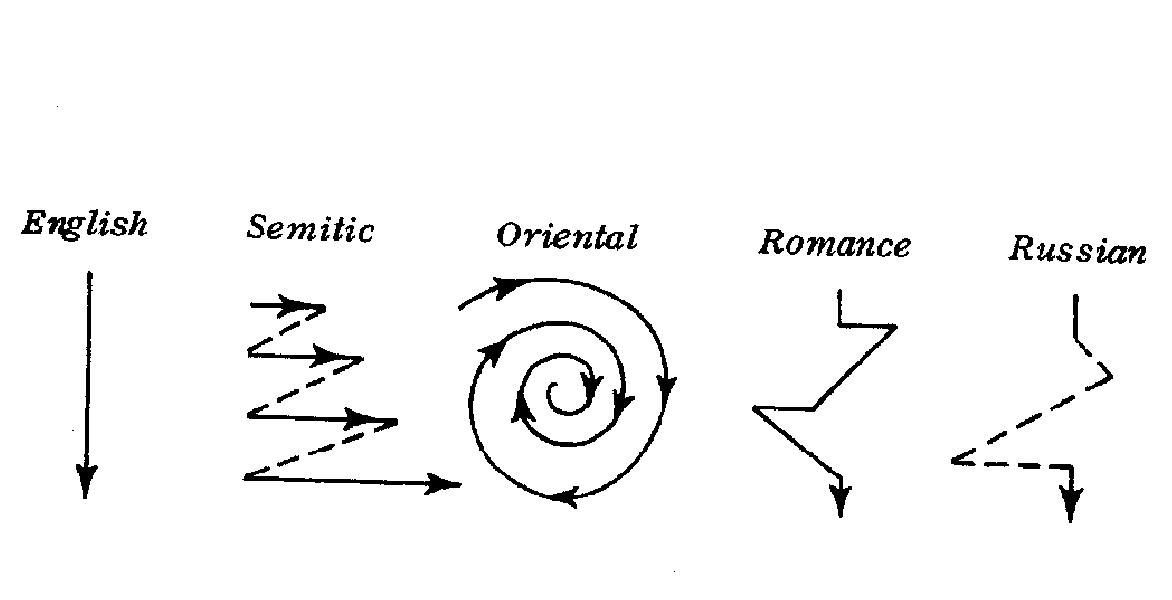
Kaplan’s diagram

The diagram describes thinking patterns of different language systems. There are two keys you can get from it:

  • English – (includes Germanic languages such as German, Dutch, Norwegian, Danish, and Swedish) Communication is direct, linear and doesn’t digress or go off topic.
  • Oriental – (Languages of Asia) Communication is indirect. A topic is not addressed head on, but is viewed from various perspectives, working around and around the point.

As we are Asian, we are likely to adopt the oriental thinking pattern, which is different from English thinking pattern.

Though Kaplan’s findings are controversial, from my editing experience, Vietnamese writing is rather oriental.

2. What is linear thinking?

A linear process moves forward like a line with a starting point and an ending point, and our brains often want to make simple straight connections in sequential order (Jody Michael).

Both intake and outflow are predictable and efficiently and orderly presented, considered, learned and written. Researchers have found out that Westerners tend to be linear thinkers, while Easterners are often non-linear thinkers.

Here’s what linear thinkers would develop a text:

Outside my window (A1) is a big garden with many kinds of plants (B1), and in the middle of the garden (A2) is a flower bed (B2). The flower bed (A3) is full of roses and tulips in the spring (B3). Roses and tulips (A4) are my favorite flowers (B4).

Can you see the connection between A2 and B1, A3 and B2, A4 and B3? — They are talking about the same things. That’s right! That’s what we call linear development.

Characteristics of each new subject are

  • Chain-like: New subjects are previously mentioned.
  • Predictable: Readers can guess what’s coming next because of it is slightly mentioned previously.

That’s how westerners process each writing!

XÍCH SẮT MẠ KẼM 8MM dài 3 mét - XS8-3m

3. How to improve our ingrained oriental thinking pattern?

Though our oriental thinking pattern is ingrained in our brain, which means we usually unconsciously think that way, we can absolutely improve it by being aware of the difference.

Let me remind you of two main characteristics of a linear text:

  • Chain-like: New objectives are developed based on their previous mention.
  • Predictable: Because of being slightly mentioned previously, new subjects are predictable.

4. How writers should apply linearity to writing.

And now, see how I applied the knowledge into writing and editing by analyzing the text below.

Q: Can you guess who crafted this piece of writing, a linear or non-linear thinker?

Every great leader is different from one another. [1] Steve Jobs, with all the ups and downs in his life, leads with courage. Bill Gates, on the other hand, leads with respect and trust he has for his employees. [2] Each belongs to a different type of leadership, [3] and understanding these types is necessary to figure out what makes the leadership gap that keeps people from achieving greatness. [4] From this point, readers will find out the type of leader they are as well as working on becoming the leader they genuinely want to be. [5]

 The answer is a non-linear thinker. Let’s analyze it!

 [1] Every great leader is different from one another.

 If the writer focuses on people like this, i’ll expect the next sentence would be like “Someone is tall; someone is short. Someone is kind; someone is cruel.” If she talked about people, this paragraph would be about people’s characteristics, wouldn’t it?

 [2] Steve Jobs, with all the ups and downs in his life, leads with courage. Bill Gates, on the other hand, leads with respect and trust he has for his employees. 

 This seems like my prediction went wrong.

[3] Each belongs to a different type of leadership

Oh. I got the key here. Now I can guess this paragraph is about the way leaders lead, not leaders as people.

=> So you see. I needed to wait until the third sentence to understand what this paragraph is really about. I agreed that I got a cue in the second sentence and not all topic sentences are at the beginning of a paragraph, but this made me confused a lot.

[4] and understanding these types is necessary to figure out what makes the leadership gap that keeps people from achieving greatness.

“Understanding these types” really bothers me. She mentioned the ways Steve Jobs and Bill Gates lead as two representatives. She haven’t mentioned the other types. We don’t even know if there are other types. Are the two ways the only leadership types?

And she thought understanding these types (referred to the two types) is all I need to achieve greatness?

Here I suggest an improved version of that text.

 There are no limitations in the way leaders execute their leadership. Steve Jobs, with all the ups and downs in his life, leads with courage. Bill Gates, on the other hand, leads with respect and trust he has for his employees. And they are only two among seven leadership types. Understanding these types is necessary to determine what makes the leadership gap that keeps people from greatness. From this point, readers will find out the leadership styles that suit them best as well as the way to become the leader they genuinely want to be.

Takeaway LessonsSo, the next time you craft a writing, please notice the connection among clauses, sentences.

  • Are they really chain-like?
  • Are they predictable?

Your writing will be logically improved a lot. I’m sure. This technique is even magnificently helpful in your IELTS writing. Let’s see how Simon, ex-IELTS examiner, suggests:

Please comment below to let us see how you feel about our regular posts. Your comments will be our motivation to share with you our knowledge to help you improve your writing skills.

From Summerian with Love ❤

Dấu câu: 90% writer đang dùng sai

Dấu câu là 1 yếu tố nhỏ trong bài viết, vì vậy thường bị người viết ngó lơ. Tuy nhiên, chúng ta phải biết rằng ngôn ngữ là công cụ truyền tải ý tưởng, và bất cứ yếu tố nhỏ nhặt nào đều có thể tác động tới trải nghiệm đọc của độc giả. Đằng nào cũng phải viết, thôi thì hãy viết cho chuẩn đi.

1. Bạn có chắc mình biết cách dùng dấu câu chuẩn?

Lúc chữa bài, mình từng gặp nhiều những bài viết được trình bày thế này. Điều này có thể thấy hầu hết writer đều chưa ý thức được quy chuẩn trong cách dùng dấu câu ở tiếng Anh Mỹ. 

Dùng sai dấu nháy đơn và dấu chấm

Ngoài ra, một số lỗi khiến writer bối rối trong việc sử dụng dấu câu như:

Ví dụThắc mắc
… oranges, apples, bananas and grapesCó nên thêm dấu phẩy giữa bananas và and grapes
Bill Gates’
Class’s
Christmas’s
Dấu móc lửng nên dùng như nào cho đúng
the U.S. hay the USChấm hay không chấm
‘dogs’ hay “dogs”Dấu ngoặc kép kép hay ngoặc kép đơn đây?
“happy.” hay “happy”.Dấu câu nên nằm trong hay nằm ngoài dấu ngoặc kép
Let’s read: BooksMagazines Chữ cái đầu câu nên viết hoa không?
his depression are: physical exhaustion, hypochondria, anxiety, có nên dùng dấu 2 chấm sau tobe không

Nếu các bạn có từng gặp những bài viết xuất hiện những lỗi như này và bối rối không biết xử trí thế nào, thì đã đến lúc phải tìm hiểu tường tận về Punctuation rồi. 

2. Nguồn tài liệu chuẩn về dấu câu

  1. Chicago Manual of Style: https://www.chicagomanualofstyle.org/search.html?clause=punctuation
  2. The Punctuation Guide: https://www.thepunctuationguide.com/

Nhân tiện, một writer dùng sai dấu trong more ‘happy’. Cách dùng đúng là more “happy.” Tìm hiểu các tài liệu trên để tìm ra nguyên nhân nhé 😉

“It’s the little details that are vital. Little things make big things happen.”

Cách xử lý lỗi chính tả

Số phận của writer chúng ta sẽ thật bi đát nếu không có các công cụ kiểm tra chính tả tự động. Tưởng tượng cảnh đầu óc lúc nào cũng phải căng ra nhìn từng từ như thể chúng có thể trở thành kẻ thù của mình bất cứ lúc nào. Công nghệ giúp chúng ta đỡ mệt não hơn rất rất nhiều. Chính vì thế, ở bài viết này, mình sẽ giới thiệu qua về một số cánh tay đắc lực của chúng ta và cách xử lý các công cụ này như thế nào.

1. Lỗi chính tả nghiêm trọng tới mức nào?

Chúng ta thường được cảnh báo về chất lượng của sách lậu như thế nào nhỉ? Chất lượng của giấy, của chữ, của nội dung,… tất cả mọi thứ đều tệ hại cho người mua, (trừ giá tiền!). Chính vì vậy, mỗi khi bắt đầu thấy lỗi chính tả nào đấy xuất hiện trong sách tiếng Việt là mình cảnh giác liền. Không biết là sách lậu thì thôi chứ biết rồi thấy mua phí tiền lắm. Cảm giác tương tự xảy ra đối với những người bản xứ hoặc cận bản xứ đọc sách bằng tiếng Anh.

Vì vậy, các writer, các bạn hãy cảnh giác! Về cơ bản, nếu không cẩn thận thì bài viết của chúng ta chắc chắn cũng sẽ khiến cho người đọc có ác cảm tương tự.

2. Các Grammar Checkers thần thánh là gì?

Ơn giời! Chúng ta đã có các công cụ kiểm tra chính tả. Sau quá trình nghiên cứu và thử nghiệm các công cụ trên mạng, dưới đây là top 3 công cụ kiểm tra chính tả và ngữ pháp tuyệt vời nhất mà chúng ta bắt buộc phải sử dụng trong quá trình chỉnh sửa bài viết. Đó là:

  • Google Docs
  • Grammarly (khuyến khích dùng bản Premium)
  • ProWritingAid (bản Free)

3. Tại sao lại phải dùng nhiều công cụ như vậy? 

Có phải ta đang mua việc không? Tại sao lại phải dùng nhiều công cụ như vậy? 

Nào có công nghệ nào hoàn hảo ngay từ đầu. Tất cả các tool này hãy còn cần phát triển dài dài để trở thành 1 Super Writer. Vậy nên, với phiên bản hiện nay của chúng, có nhiều lỗi công cụ này thất bại trong việc phát hiện lại được công cụ khác nhận ra. Việc kiểm tra bài viết qua nhiều lớp là một cách hữu hiệu để tránh bỏ sót những lỗi chính tả chưa cần dùng đến sức người.

4. Dùng các công cụ này như nào cho hiệu quả?

Trong bài viết, khi đã chốt nội dung về Idea Formation (what should be included/excluded, structure, idea arrangement,..), đó là lúc chúng ta bắt đầu nên xử lý các lỗi thuộc về Idea Expression (grammar, orthography, word choice, style,…).

Thành thật mà nói, một writer không phải người bản xứ gần như không thể tự tay viết một bài error-free. Để tránh lỗi chính tả hết sức có thể, trước khi nộp bài viết, các bạn hãy tham khảo lần lượt các tool sau đây để chỉnh sửa bài viết tốt nhất.

1. Google Docs

Khi bật chức năng autocorrect trên Google Docs, các lỗi chính tả, lỗi ngữ pháp sẽ được đánh dấu như thế này. Thật tuyệt phải không!

*Phải cài ngôn ngữ Anh (Mỹ) thì tool mới phát hiện lỗi.

2. Grammarly

Grammarly là công cụ top đầu về kiểm tra lỗi chính tả, ngữ pháp, văn phong, ngôn từ, tính nhất quán trong cách dùng từ. Việc sử dụng Grammarly sẽ rất tốt cho việc học, việc làm liên quan tới viết lách bằng tiếng Anh.

*Mình khuyến khích các bạn mua chung account Grammarly để tiết kiệm chi phí.

7 Best Grammarly Alternatives (2020) To Improve Your Writing

3. ProwritingAid

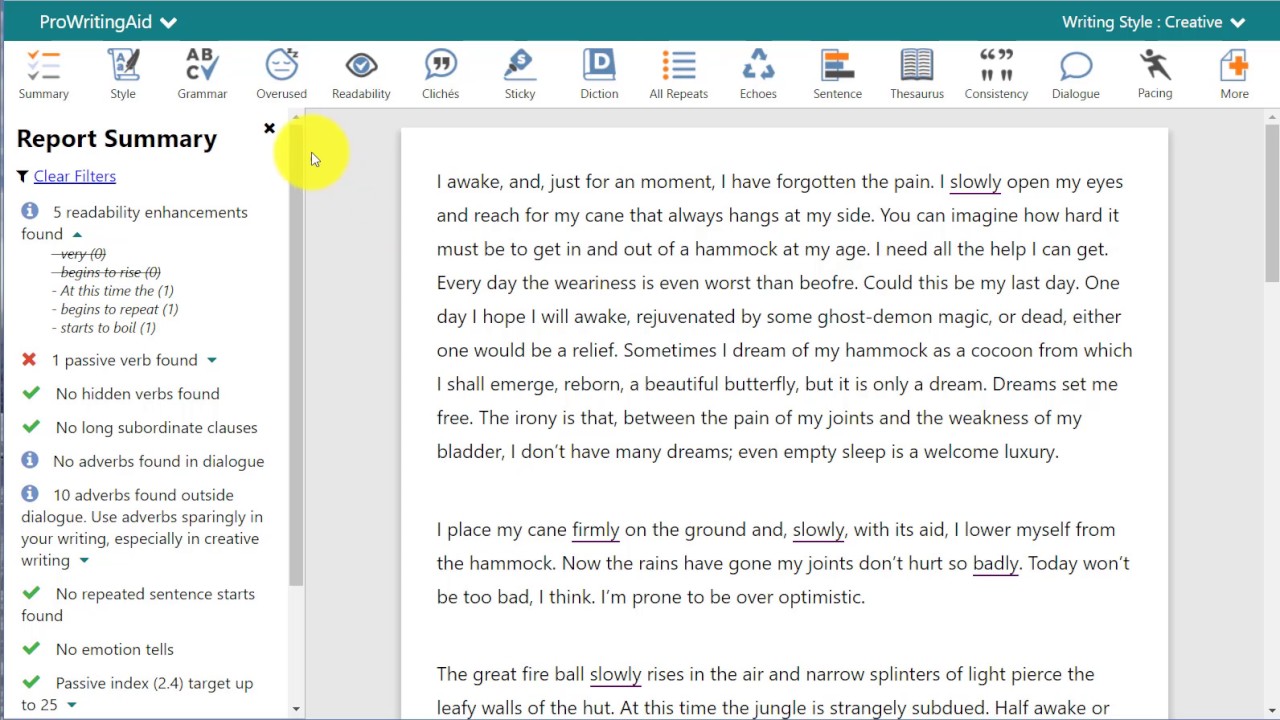
Điều mình nhận ra là nhiều lỗi bị bỏ sót bởi Google Docs, Grammarly lại được ProWritingAid phát hiện ra. Cẩn thận không bao giờ là thừa.

Tuy nhiên, các bạn cũng cần lưu ý là word choice của ProWritingAid thiên về dùng từ đơn giản, nhưng lại không hay. Ví dụ to “make a decision” sẽ bị ProWritingAid gợi ý là “to decide.”

ProWritingAid Introduction - YouTube

5. Tạm kết

Mặc dù là toolkit vô cùng đắc lực, các công cụ kể trên dù sao vẫn chỉ sử dụng là công nghệ AI, không phải là con người với ý đồ viết nhất định. Trong trường hợp những lỗi được gợi ý cách sửa là sai lệch với ý đồ của bạn, bạn hoàn toàn có thể lơ nó đi. Tuy nhiên, phải chắc chắn là bạn biết chắc là nó gợi ý sai ý đồ của bạn nhé 😉

Writers should be tough readers!

Summerian